


Views: 0 Author: Site Editor Publish Time: 2026-11-06 Origin: Site


Chasing the perfect mahogany crust on a smoked brisket remains the ultimate test for any pitmaster. Transitioning from thin-walled metal smokers to heavy ceramic grills introduces a frustrating reality. Carefully crafted bark often turns out disappointingly mushy or scorched black on the bottom. The secret to bridging this performance gap lies in mastering the heat deflector. This vital accessory is essential for low-and-slow smoking. It fundamentally alters the thermodynamics of the grill. By shifting airflow patterns, moisture retention, and thermal distribution, the shield directly dictates crust formation. In this engineering-focused guide, we explore the underlying fluid dynamics of bark development. We analyze how a ceramic barrier changes the cooking environment and share actionable techniques to achieve competition-level results.
A kamado accessory converts a direct-heat oven into an indirect smoking environment. This prevents proteins from incinerating before internal collagen breaks down.
Bark forms via the Maillard reaction, spice polymerization, and smoke adhesion. These chemical processes demand a precise balance of draft velocity and surface moisture.
Ceramic shields absorb and emit intense thermal energy. This radiant output will overcook the bottom of the meat if not strategically managed.
Introducing a catch pan with a dedicated air gap is mandatory. It protects the bottom crust and regulates dome humidity.
Mastering this specific setup guarantees consistent crust formation. You eliminate the need to constantly flip heavy proteins during long sessions.
A kamado heat deflector sits between the glowing charcoal bed and the primary cooking grate. Seasoned users often refer to this component as a plate setter. Manufacturers typically craft it from thick cordierite ceramic. Its primary function is blocking the direct line of sight between the open fire and the food.
Grasping the distinction between direct and indirect thermal transfer is foundational. Direct grilling places food right over an open flame. This method utilizes intense infrared energy to rapidly crisp the exterior of steaks or burgers.
Conversely, tackling tough cuts like briskets or pork shoulders requires a different approach. Placing these proteins directly over hot coals incinerates the outside long before internal fats render. The deflector acts as an impenetrable physical shield. It forces heat and wood smoke to travel around the outer edges of the ceramic plate. This effectively transforms the grill into a highly efficient indirect cooking convection oven.
Recent market data shows a massive industry migration. Enthusiasts and competitive teams are moving from traditional offset stick-burners to highly insulated ceramic grills. Market analysts attribute this shift to unparalleled fuel efficiency and superior weather resistance. However, this trend exposes a steep learning curve regarding grill thermodynamics. Modern pitmasters are abandoning old-school recipes. They opt instead for a scientific approach to manipulate thermal mass and convection currents. This precision is required to replicate authentic offset-style bark in a sealed ceramic environment.
Before analyzing how the deflector alters the internal environment, we must define bark. It is not burnt meat. It is not merely dried-out spices. Bark is a complex, deeply flavorful crust formed through specific chemical and physical reactions.
The chemical foundation of any great crust is the Maillard reaction. Amino acids in the meat react with reducing sugars from the rub. Exposed to sustained heat—usually kicking in around 285°F to 325°F—these compounds recombine. They generate hundreds of new flavor molecules and a distinct dark mahogany color.
Simultaneously, physical polymerization takes place. As internal temperatures climb, intramuscular fat renders and migrates to the surface. This liquid fat mixes with water-soluble spices. Over several hours, sustained heat causes this paste to polymerize. It hardens into a semi-solid layer called a pellicle, eventually dehydrating into a crusty exterior.
Smoke provides more than a savory aroma. Smoldering wood chunks release microscopic particles that adhere to the sticky meat surface.
Nevertheless, for the bark to fully set, moving air is an absolute necessity. The airflow inside the grill must be vigorous enough to evaporate excess surface moisture. If the environment becomes stagnant, the surface remains wet. The bark washes off or turns into a mushy paste. On the flip side, excessively rapid airflow strips too much internal moisture. This results in a tough, jerky-like texture.
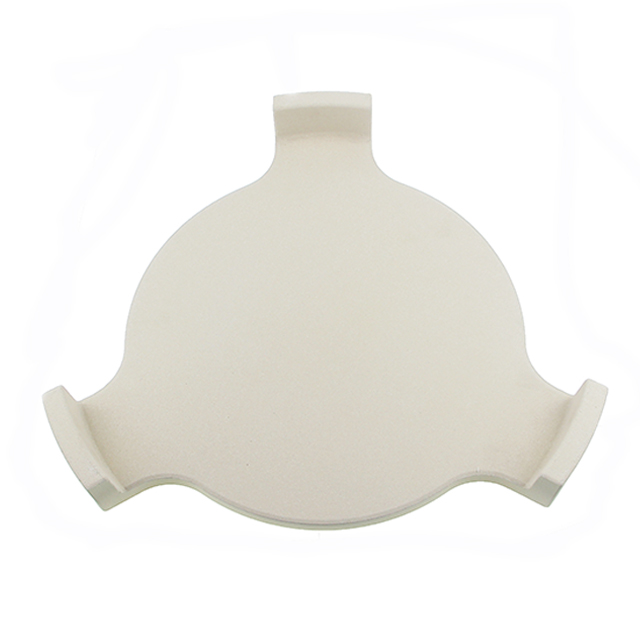
Introducing a thick ceramic shield into a tightly sealed vessel fundamentally alters fluid dynamics. This single piece of equipment directly dictates thermal distribution.
The most immediate benefit is preventing grease fires. Smoking a fatty pork butt without a shield allows rendering fat to drip onto white-hot coals. This triggers intense flare-ups and generates billowing, acrid smoke. Bitter soot coats the meat, turning the exterior into a carbonized shell. By deflecting these drippings, the ceramic ensures only clean, thin blue smoke interacts with the protein.
A kamado operates naturally on draft convection. Cool air enters the bottom vent, fuels the firebox, and hot air exhausts out the top. Installing a deflector abruptly interrupts this vertical draft. The rising hot air is forced outward. It squeezes tightly through the narrow annular gap between the ceramic edge and the inner grill walls. It sweeps upward along the curved dome, creating a swirling convection vortex.
Consequently, the top and sides of the protein are constantly bathed in moving, drying air. This accelerates bark formation on those surfaces. Conversely, the bottom of the meat sits in a wind shadow. Shielded from the drying draft, it faces a vastly different type of energy.
While a deflector is the cornerstone of low-and-slow cooking, its massive thermal mass causes uneven crusts. The bottom of the meat frequently cooks at a radically different pace than the top.
In a standard configuration, the deflector hovers inches above glowing lump charcoal. The porous ceramic continuously absorbs infrared energy. Because these grills are highly insulated, trapped heat cannot escape quickly. The ceramic reaches temperatures dwarfing the ambient air reading inside the dome. Your dome thermometer might display a perfect 250°F. Meanwhile, the actual surface of the heat deflector directly below the meat could easily radiate at 400°F or more.
This intense radiant heat literally bakes the underside of the protein. Electromagnetic waves directly and aggressively heat whatever sits in their line of sight. A moderate dose of bottom heat assists in rendering a thick fat cap. However, excessive energy emitted by an unshielded deflector results in a scorched, inedible bottom crust. Resting meat too close to this glowing plate burns delicate sugars and tightens muscle fibers.
To neutralize the radiant energy problem, pitmasters must intentionally introduce a thermal buffer. This transitions a drip pan from a helpful accessory to a mandatory piece of engineering.
A remarkably common mistake is placing a metal catch pan flush against the ceramic deflector. Metal is a highly efficient conductor. The extreme temperature of the ceramic instantly transfers into the pan, aggressively boiling or burning collected liquids.
To circumvent this, you must engineer an air gap. Position spacers—such as crushed aluminum foil balls, thick stainless steel nuts, or a specialized rack—between the ceramic plate and the pan. This half-inch gap completely severs direct conductive heat transfer. It keeps the pan significantly cooler than the glowing ceramic beneath.
Once the air gap is established, the pan performs dual duties. It catches rendered fat and regulates dome humidity. Liquid fat dripping into a cooler, air-gapped pan pools safely instead of vaporizing. Burning fat creates a harsh smoke that imparts a bitter taste to the bark.
Furthermore, operators hold the power to dictate moisture levels. Adding water creates high humidity, stabilizing temperature fluctuations but drastically slowing bark formation. Kamados naturally retain moisture far better than thin-metal offset smokers. Therefore, running a completely dry pan is heavily recommended for most cooks. This ensures the meat surface dehydrates sufficiently to form a proper pellicle.
The physical properties of your deflector dictate its performance. Using makeshift barriers compromises the thermodynamic balance. Professional-grade accessories are engineered specifically for this environment.
When selecting a deflector, material density and thermal shock resistance are paramount. Premium components utilize high-grade cordierite ceramic. This material is fired at extremely high temperatures, allowing it to withstand up to 1000°C without cracking. Its specific thickness ensures steady, predictable heat radiation rather than erratic temperature spikes.
Setup Type | Thermal Mass | Radiant Heat Control | Impact on Bark Formation |
|---|---|---|---|
No Deflector (Direct Fire) | None | Zero (Direct Flame) | Incinerates exterior before rendering internal fat. |
Thin Metal Shield | Low | Poor (Warps & Conducts) | Creates hot spots; bottom bark scorches easily. |
TOPQ Cordierite Plate Setter | High | Excellent (Absorbs & Radiates Evenly) | Produces competition-level, mahogany crust with consistent convection. |
Grasping the underlying physics is only half the battle. Applying these field-tested techniques ensures you pull competition-level bark every time you fire up the coals.
The physical distance between the meat and the ceramic plate dictates radiant energy absorption. Whenever the grill design allows, elevate the cooking grates. The higher the meat sits inside the ceramic dome, the more uniform the bark becomes. Elevating the protein removes it from the intense radiant heat zone. It places the meat higher into the convection vortex, allowing hot, swirling air to dry the exterior evenly.
Because the deflector restricts airflow compared to stick-burners, moisture does not escape easily. Consequently, the popular technique of spritzing meat every 45 minutes is largely unnecessary. Recipes designed for drafty offset smokers rely on heavy spritzing to prevent meat from turning to leather. Blindly applying this method in a tightly sealed ceramic grill causes excess liquid to pool. This actively prevents the Maillard reaction from setting the rub. Over-spritzing is the leading cause of mushy bark in kamados. Only spritz the very edges, and only if they look visibly charred.
Wrapping meat is a standard practice to push through the BBQ stall. However, wrapping too early effectively steams the meat, destroying the crust.
When operating a kamado, strongly consider the Foil Boat method instead of a full wrap. Wrap only the bottom half of the brisket or pork butt in heavy-duty aluminum foil. Leave the top completely exposed. This achieves two critical goals. First, it adds an extra layer of protection for the bottom bark against radiant heat. Second, it leaves the top bark fully exposed to convection currents. The crust continues rendering and hardening without becoming soggy.
Even with a flawless setup, environmental variables impact the cook. Below is an empirical breakdown of common bark failures, underlying thermodynamic causes, and actionable solutions.
A paste-like exterior occurs when surface moisture fails to evaporate. Primary culprits include placing too much water in the drip pan, keeping the top exhaust vent closed too tightly, or wrapping the meat before the crust sets.
To correct this, evaluate the moisture management strategy. Run the grill with a completely dry, air-gapped catch pan. Open the top exhaust vent slightly more to promote a stronger draft. Moving air carries excess humidity out of the dome. Always utilize the scratch test before wrapping. Drag a fingernail lightly across the crust. If the rub scrapes off easily, it requires more time exposed to convection currents.
This asymmetrical profile is the direct result of unmanaged radiant energy. It happens if the meat sits too close to the deflector, if no thermal barrier was utilized, or if the fire spiked early in the cook.
The solution relies on distance and shielding. Elevate the cooking grates. Always use a catch pan with proper metal spacers to break conductive heat transfer. Most importantly, bring the kamado up to target temperature incredibly slowly. Overshooting the temperature and choking the vents leaves the thick ceramic holding excess heat for hours, ruthlessly baking the bottom.
An acrid sensation indicates that creosote or vaporized rancid carbon adhered to the meat. In a kamado setup, this is rarely caused by wood chunks. It is typically the result of a dirty deflector. Rendering fat dripping onto a porous, unshielded ceramic surface vaporizes into thick, bitter smoke.
Prevention is the only defense. Always utilize a catch pan. Wrap the ceramic piece in heavy-duty aluminum foil prior to installation. This provides an expendable layer that catches rogue splatters. Discard it after the cook to ensure the environment produces only clean, thin blue smoke.
A crust resembling hard leather is the result of excessive surface dehydration. This happens when airflow is too aggressive, ambient humidity drops too low, or the sugar content in the spice rub is too high. High concentrations of sugar crystallize and burn when exposed to prolonged dry heat.
To mitigate this, lightly spritz the meat with apple cider vinegar to cool the surface. Reconsider the rub formulation by substituting refined white sugar with turbinado sugar. Once the desired crust thickness is achieved, wrap the meat in unlined butcher paper. This protects the bark from further dehydration while allowing it to breathe.
The physical condition of ceramic accessories plays a critical role in bark formation. Cordierite ceramic is highly porous. Left unprotected, it absorbs liquid fats over time. During subsequent high-temperature cooks, these embedded oils seep out and combust. This fundamentally alters the chemical composition of the smoke.
Routine maintenance is required. If the deflector has absorbed grease, clean it through a high-heat burn-off. Place the deflector in the kamado and gradually raise the temperature to 500°F for approximately one hour. This carbonizes trapped organic matter into fine white ash. Exercise strict caution to avoid thermal shock. Never introduce a cold ceramic plate into a raging fire, and never apply water to it while hot.
A kamado heat deflector is an absolutely non-negotiable tool for traditional barbecue. It fundamentally transforms the grill into a highly efficient smoker. Achieving that perfect mahogany crust requires a deep understanding of how this thick ceramic shield alters the internal environment.
Actively controlling radiant heat and strategically managing moisture with an air-gapped drip pan unlocks competition-quality bark. Understanding the nuances of indirect convection airflow eliminates the days of accepting mushy or scorched meat.
Before firing up the coals for the next brisket, double-check the deflector setup. Implement the air-gapped catch pan method, elevate the grates, and watch the crust improve dramatically. For pitmasters looking to upgrade their hardware, selecting premium cordierite accessories is crucial. Visit TOPQ Kamado Grills to explore professional-grade heat deflectors and ceramic accessories designed to perfect your next low-and-slow session.
Yes, a pizza stone functions similarly by providing a ceramic barrier. However, there are critical engineering caveats. A dedicated plate setter features specific thickness and dimensions to optimize airflow around the firebox perimeter. Standard pizza stones are often too thin. They may crack under prolonged exposure to intense thermal energy. Furthermore, a pizza stone lacks integrated legs, requiring custom rigging to support cooking grates.
Absolutely. Wrapping the deflector in heavy-duty aluminum foil is a highly recommended best practice. Cordierite ceramic readily absorbs rendering fats and meat juices. If these liquids bake into the ceramic, they turn rancid. Wrapping creates an impermeable, disposable barrier. This makes post-cook cleanup easier and prevents old grease from ruining the flavor of future cooks.
Kamados are highly insulated vessels that retain massive amounts of moisture. If bark fails to form, the thermodynamic environment inside the dome is likely too humid. Bark formation relies on the Maillard reaction, requiring the meat surface to dehydrate slightly. If a large water pan is used or the top exhaust vent is closed too tightly, evaporated moisture cannot escape. Run a dry catch pan and open the top vent slightly to increase the convection draft.
For smoking applications, always place the deflector in the legs-up orientation. Pointing the legs upward serves a crucial structural purpose. It provides a stable platform to rest stainless steel cooking grates. More importantly, this orientation creates a vital spatial cavity between the flat ceramic surface and the cooking grate. This is exactly where the air-gapped drip pan must sit to protect meat from radiant heat.
For optimal thermal mass and stable heat radiation, a professional-grade cordierite heat deflector should be at least 0.6 to 0.8 inches thick. Thinner profiles struggle to absorb the intense infrared energy from the charcoal bed. This leads to erratic temperature spikes and scorched bottom bark. A thicker plate setter acts as a superior thermal battery, ensuring the steady, low-and-slow convection required for perfect polymerization.
While durable, leaving the deflector in the grill during high-heat direct searing is not recommended. Exposing the ceramic to extreme direct flames exceeding 700°F unnecessarily stresses the material. It also blocks the infrared energy needed to sear steaks properly. Remove the deflector for direct grilling, and only install it when setting up for indirect smoking or baking.


