


Views: 0 Author: Site Editor Publish Time: 2026-06-05 Origin: Site


Transitioning from an automated pellet smoker to a manual ceramic grill presents a noticeable learning curve. Achieving a consistent "low and slow" temperature between 225-275°F requires strategy and patience. Ceramic materials retain heat exceptionally well. This natural insulation maximizes meat moisture and overall fuel efficiency. However, this exact trait introduces a significant risk. Overshooting your target temperature becomes a costly mistake when you are cooking expensive cuts of meat.
Our goal is to eliminate the guesswork. We provide an evidence-based, mechanical framework for setting, stabilizing, and troubleshooting your grill for long cooks lasting over 10 hours. You will learn to manage airflow proactively rather than reacting to rapid temperature spikes. By mastering these precise vent control techniques, you will unlock unmatched barbecue flavor and build lasting confidence in your outdoor cooking skills.
**Ceramic Physics:** A kamado's thick walls absorb and radiate heat; once overheated, it takes hours to cool down. Always start low.
**Vent Roles:** Think of the bottom vent as the "accelerator" (macro control) and the top vent as the "brake" (micro control).
**The 50°F Trigger:** Begin aggressively damping down your vents when you are 50°F away from your target temperature to prevent momentum overshoots.
**Hardware Dependencies:** Long cooks require high-quality lump charcoal, a heat deflector (indirect cooking), and proper "heat soaking" of the ceramic dome before adding meat.
Switching to a ceramic grill demands a major mindset shift. You must abandon the set-it-and-forget-it convenience of electronic augers. You now manage the Fire Triangle manually. This framework requires you to balance fuel, heat, and oxygen perfectly. Every adjustment you make directly impacts the core temperature. You control the oxygen intake, determining exactly how the fire behaves.
Ceramic excels for low and slow cooking, typically falling between 107-135°C (225-275°F). The heavy walls require minimal airflow to maintain steady heat. This creates a distinct advantage over thin-walled metal offset smokers. A lower draft pulls significantly less moisture out of the meat. Your briskets and pork shoulders remain tender and juicy. The environment inside the dome acts similarly to a convection oven, circulating gentle heat around the food.
However, this intense heat retention carries a major risk factor known as heat momentum. Ceramic is a powerful insulator. It absorbs heat deeply into its walls. If your grill accidentally hits 400°F, you face a serious problem. You cannot dial it back down to 250°F quickly. You will need complex manual intervention to shed that trapped thermal energy. Recognizing this momentum is the most critical step in mastering your appliance.
Feature | Ceramic Grill | Pellet Smoker |
|---|---|---|
Airflow Dynamics | Low draft, minimal air movement | High draft, forced air fan system |
Moisture Retention | Excellent (seals in meat juices) | Moderate (requires constant basting) |
Temperature Reduction | Extremely slow (takes hours to cool) | Relatively fast (metal sheds heat quickly) |
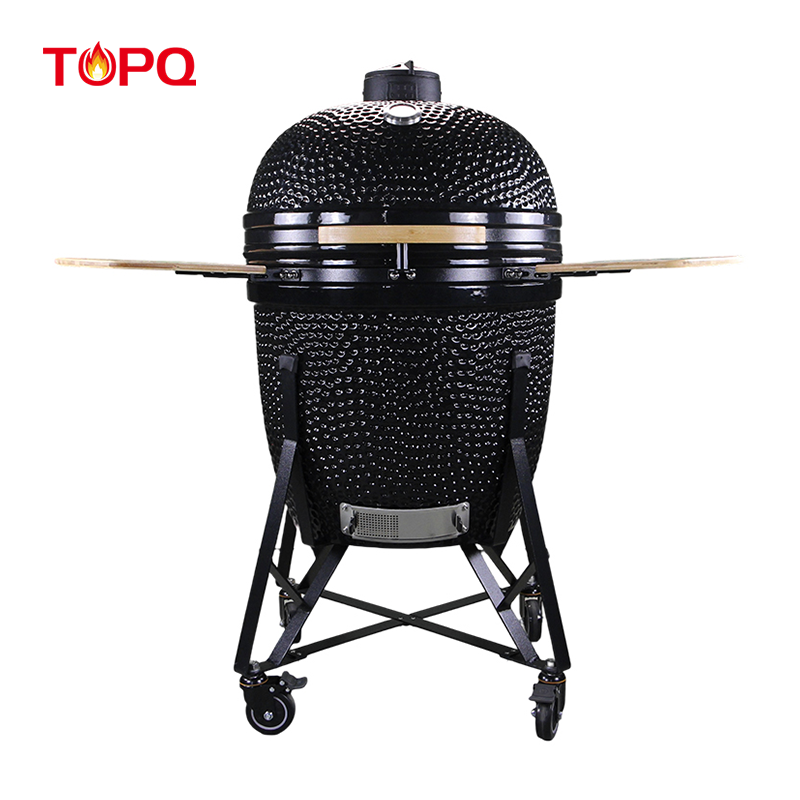
Proper preparation dictates your success before you even light a fire. Fuel selection remains paramount. You must use 100% hardwood lump charcoal. Never use synthetic briquettes for long cooks. Briquettes create excess ash. This ash inevitably chokes the bottom draft door, suffocating your fire mid-cook. Furthermore, never use lighter fluid. The porous ceramic interior will absorb chemical odors permanently. These chemicals will taint every future meal you prepare.
Loading your charcoal requires a specific technique. We strongly recommend the Minion Method for cooks exceeding 10 hours. This approach ensures a slow, steady burn without requiring fuel refills. Follow this exact sequence to arrange your firebox:
Clean out all old ash from the firebox and bottom draft door.
Place large, unlit chunks of lump charcoal at the very bottom of the fire grate.
Layer medium-sized charcoal chunks over the larger base pieces.
Pour a small chimney of fully lit coals directly onto the very top center.
Allow the fire to slowly burn downward over the next 12 to 15 hours.
Indirect cooking configuration is mandatory for smoking meat. You must install the heat deflector, often called a plate setter, very early in the process. Placing it early allows the ceramic plates to absorb rising heat gradually. This prevents scorching the underside of your meat. Next, you must place a drip pan directly on top of the heat deflector. We recommend filling this pan halfway with warm water. The water creates a thermal buffer. It absorbs aggressive heat spikes and stabilizes temperature fluctuations throughout the night.
Finally, you must respect the dome heat soaking phase. Many beginners fail here. Your ambient probe might read 250°F within 10 minutes of lighting the fire. However, the grill is not truly stable yet. You must wait 15 to 20 minutes. The thick ceramic walls must absorb the initial heat. Place your hand carefully on the exterior ceramic dome. It should feel warm to the touch. Once the dome is thoroughly heat soaked, the internal temperature will hold steady for hours.
Mastering temperature requires you to understand airflow mechanics. You should view your upper and lower vents as driving controls. The bottom vent acts as your accelerator. It manages the total oxygen intake. Oxygen dictates the absolute ceiling of your heat output. For a standard 225-275°F cook, set the baseline opening to approximately one inch. This roughly equals one finger-width of clearance. Establish this baseline immediately after the initial lighting phase.
Conversely, the top vent serves as your brake and steering wheel. It controls the exhaust rate. It dictates the intensity of the "chimney effect" pulling air through the Kamado. When cooking low and slow, the main sliding top vent should remain nearly closed. You will rely entirely on the smaller daisy wheel or top damper. Adjust these tiny openings to look like small crescent moon slivers. This provides precise, micro-level exhaust control.
When you need to adjust temperatures, you must follow the Rule of Halves. Novices often panic and open vents completely. This ruins the cook. Instead, apply these micro-adjustment best practices:
Assess the trend: Identify if the temperature is climbing or falling steadily.
Apply the 50% rule: Only close or open the current vent gap by exactly half of its current position.
Exercise patience: Wait 10 to 15 minutes to observe the result on your thermometer.
Refine further: Make another 50% adjustment only if the temperature remains unstable after the waiting period.
You cannot wait until you reach your target temperature to close your vents. If you leave the vents wide open until you hit 250°F, you will fail. The fire's natural momentum will carry the grill past 350°F easily. You must adopt a glide path approach. This means gently coasting into your desired temperature zone.
We utilize strict trigger points to manage this momentum. Start your ignition with both vents wide open to establish a clean draft. Monitor your ambient probe closely. You must trigger the lockdown exactly 50°F before your target. For example, if your goal is a 250°F cook, your trigger point is 200°F. The moment you cross 200°F, reduce the bottom vent to one inch. Simultaneously, reduce the top vent to mere millimeters. The temperature will slowly creep up those final 50 degrees and stop precisely on target.
Monitoring your cook correctly is just as important as vent control. Emphasize reliance on a high-quality dual-probe thermometer. One probe monitors the grate temperature, and the other monitors the meat. You must resist the urge to open the dome. The golden rule applies here: "If you're lookin', you ain't cookin'." Every single lid opening causes immediate heat loss. Worse, it is immediately followed by a rapid influx of fresh oxygen. This massive oxygen rush hits the lit coals. You risk a sudden, aggressive temperature spike that takes an hour to correct.
Even experienced cooks face unexpected temperature spikes. Knowing how to combat an overshoot separates beginners from seasoned pitmasters. You need distinct protocols based on the severity of the heat spike.
For a standard overshoot (running 15-30 degrees too hot), employ the standard cooling protocol. Close all vents completely for exactly five minutes. This intentionally chokes the oxygen supply. The fire will dim quickly. After five minutes, reset your vents to slightly smaller gaps than your previous baseline. Wait another 15 minutes for the grill to settle into its new rhythm.
For a severe overshoot, you might need the emergency cooling protocol. You can open the lid for 30 seconds to dump massive amounts of trapped heat. However, you must completely close the bottom vent first. This step is non-negotiable. If the bottom vent remains open while you lift the lid, you create a massive updraft. Fresh air will violently fan the coals. You will inadvertently ignite a roaring fire, making the problem significantly worse.
External weather variables also require mid-cook adjustments. You cannot use the same vent settings year-round. Cold weather drains heat from the exterior ceramic. You will need a slightly wider bottom vent baseline and a longer preheat session. High winds create dangerous forced drafts. Wind pushes excess air through the bottom intake. You must construct a physical windbreak to shield the bottom vent during stormy weather.
Finally, you must understand the infamous meat stall. Around 160°F, large cuts of meat stop rising in temperature. They hit a plateau that can last for hours. This is evaporative cooling. As moisture sweats out of the meat, it cools the surface. This is not a fire management failure. Do not panic. Do not chase the stall by drastically opening your vents. Doing so will ruin your cook. Instead, wrap the meat tightly in butcher paper or aluminum foil. This pushes the meat through the stall while preserving your perfectly dialed-in temperature.
Mastering temperature control on a heavy ceramic grill requires immense patience. You must anticipate thermal changes rather than merely reacting to them. You must respect the thermal mass of the appliance. Adjusting vents requires a delicate, intentional approach. When you stop fighting the grill and start guiding it, the results are phenomenal. The reward is unmatched fuel efficiency and deeply complex smoke flavor.
We highly recommend investing in a reliable dual-probe thermometer setup immediately. Quality data prevents panic adjustments. For your first low-and-slow run, start with a forgiving cut of meat. A pork shoulder is highly resilient to minor temperature fluctuations. It allows you to build crucial muscle memory with your vents without the stress of ruining an expensive brisket. Take your time, apply the 50-degree rule, and enjoy the process of traditional fire management.
A: It typically takes 30 to 45 minutes. This timeframe accounts for the initial charcoal ignition and the essential ceramic heat soaking phase. Rushing this process leads to unstable temperatures later.
A: Temperature drops usually result from ash buildup blocking the bottom draft door. It can also happen if you run out of large lump charcoal. You will need to clear the ash grate using an ash tool to restore proper airflow.
A: Yes. Automated blower attachments can be mounted directly to the bottom vent. They mimic the set-and-forget convenience of a pellet smoker. This bridges the gap perfectly between manual fire management and automatic digital control.


